
Local vs Cloud AI
Last updated on 2026-08-27 | Edit this page
Overview
Questions
- When should I use cloud AI vs. local AI on Sagehen HPC?
- What are the tradeoffs in quality, speed, privacy, and cost?
Objectives
- Compare cloud and local AI on privacy, quality, speed, and cost
- Apply the decision framework to real research scenarios
- Understand when each approach is most appropriate
Cloud AI (ChatGPT, Claude, Gemini)
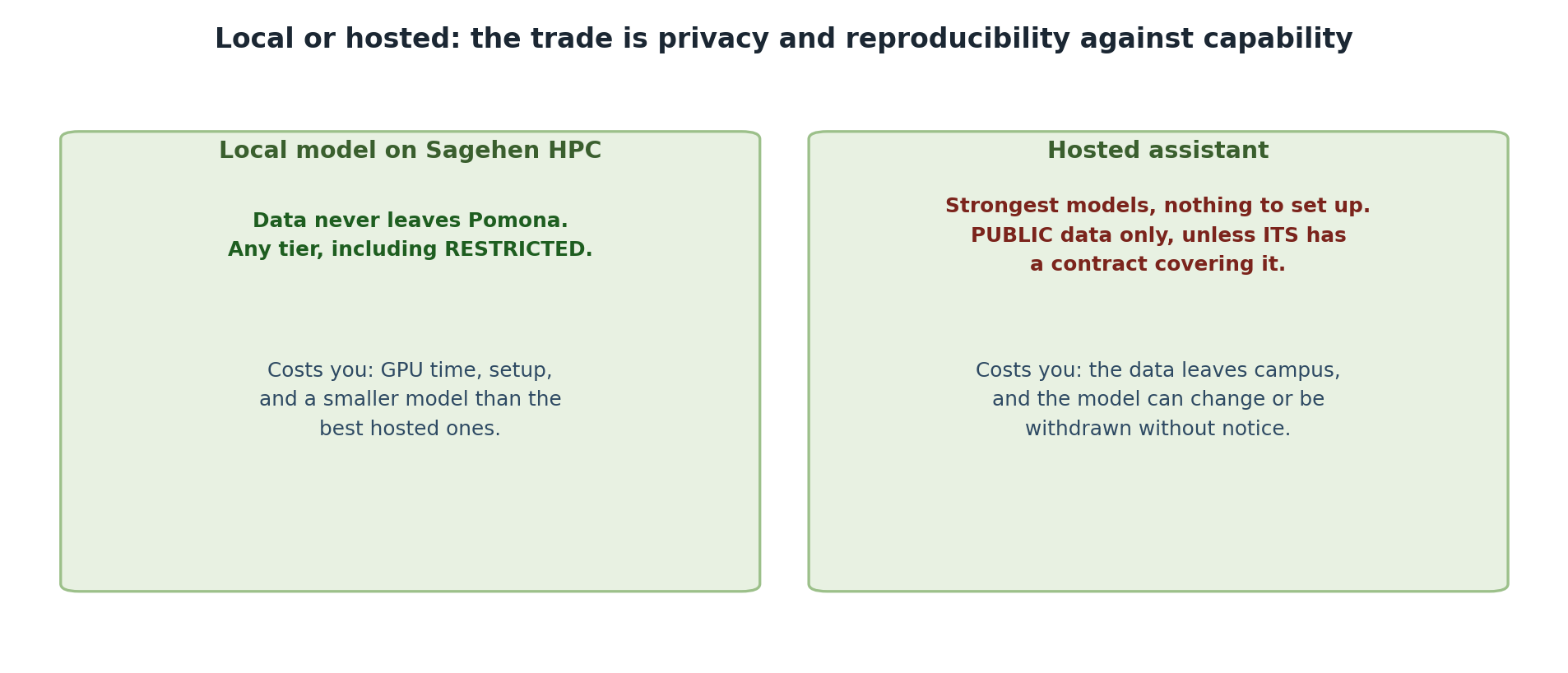
Pros: the strongest available models, no setup required, instant responses, continuous improvement, works from anywhere.
Cons: data sent to external servers, no control over data retention, cannot use RESTRICTED data, subscription costs, API rate limits, and the model can change or be withdrawn underneath you — which breaks reproducibility.
Best for: PUBLIC data, quick answers, rapid prototyping.
Local AI (Run on Sagehen HPC)
Pros: Data stays on Pomona infrastructure, can use RESTRICTED and PROPRIETARY data, no subscription cost, full control, reproducible results.
Cons: generally smaller models than the leading hosted ones, setup required, slower responses (GPU-dependent), GPU queue wait times.
Best for: RESTRICTED data, sensitive research, reproducible pipelines, batch processing.
Decision Framework
Use Cloud AI (ChatGPT/Claude) when:
  Data is PUBLIC
  Speed is critical
  You need the strongest available model
  One-off questions

Use Local AI (Sagehen) when:
  Data is RESTRICTED or PROPRIETARY
  Reproducibility matters
  Privacy is critical
  Batch processing many documents
  Cost matters at scale
When to Use Each: Examples
Cloud AI appropriate: - Drafting and editing text with ChatGPT (non-sensitive) - Exploring general research questions - Code generation and debugging - Summarizing published articles
Local AI required: - Analyzing student survey data (FERPA) - Processing lab proprietary datasets - Fine-tuning on domain-specific text - Running vision models on medical images - Batch processing hundreds of files
Cloud AI Concerns to Remember
- Data privacy: All input is sent to external servers
- Data retention: Unclear long-term data handling by providers
- Cost at scale: Expensive for thousands of queries
- Dependency: Service changes or shutdowns affect your work
- Cannot use: FERPA, medical data, export-controlled information, unpublished proprietary data
Challenge: AI Tool Selection Matrix
For each scenario, decide: cloud AI, local AI on Sagehen, or “don’t use AI”:
- Analyzing published climate data for weather predictions
- Writing code to analyze student mental health surveys (with student IDs)
- Generating creative text for a novel
- Summarizing your lab’s unpublished methods
- Creating visualizations of a proprietary compound database
- Translating published papers from Spanish to English
- Climate data (PUBLIC): Cloud AI acceptable.
- Student surveys with IDs (RESTRICTED/FERPA): Local AI ONLY on Sagehen.
- Creative text (no research data): Cloud AI fine.
- Unpublished methods (PROPRIETARY): Local AI preferred; external only with PI written permission.
- Proprietary database (PROPRIETARY): Local AI only or request approval.
- Published papers (PUBLIC): Cloud AI acceptable.
Data classification – not AI capability – determines the choice.
- Cloud AI is faster and higher quality but sends data externally
- Local AI on Sagehen keeps data private and is cost-effective at scale
- Data classification determines which approach is allowed
- Cloud AI is never acceptable for RESTRICTED or uncleared PROPRIETARY data
- Build workflows that use cloud AI for public data and local AI for sensitive data