
Responsible AI Practices
Last updated on 2026-08-27 | Edit this page
Overview
Questions
- How do I properly disclose AI tool usage in research?
- How do I verify AI-generated content for accuracy?
- What are hallucinations and how do I detect them?
Objectives
- Properly disclose AI usage in publications and code
- Verify AI-generated claims, citations, and code
- Detect and address AI hallucinations
- Write responsible AI disclosure statements
Plagiarism and Attribution
Modern AI makes plagiarism easier but also more detectable. Requirements:
- Explicitly disclose AI tool use in your work
- Quote or clearly mark AI-generated text
- Cite the model and version used
- Describe your modifications and verification
Example disclosure: “I used gpt-oss-20b running on Sagehen HPC to generate initial outlines. The model produced: [quote]. I then revised and verified all claims with primary sources.”
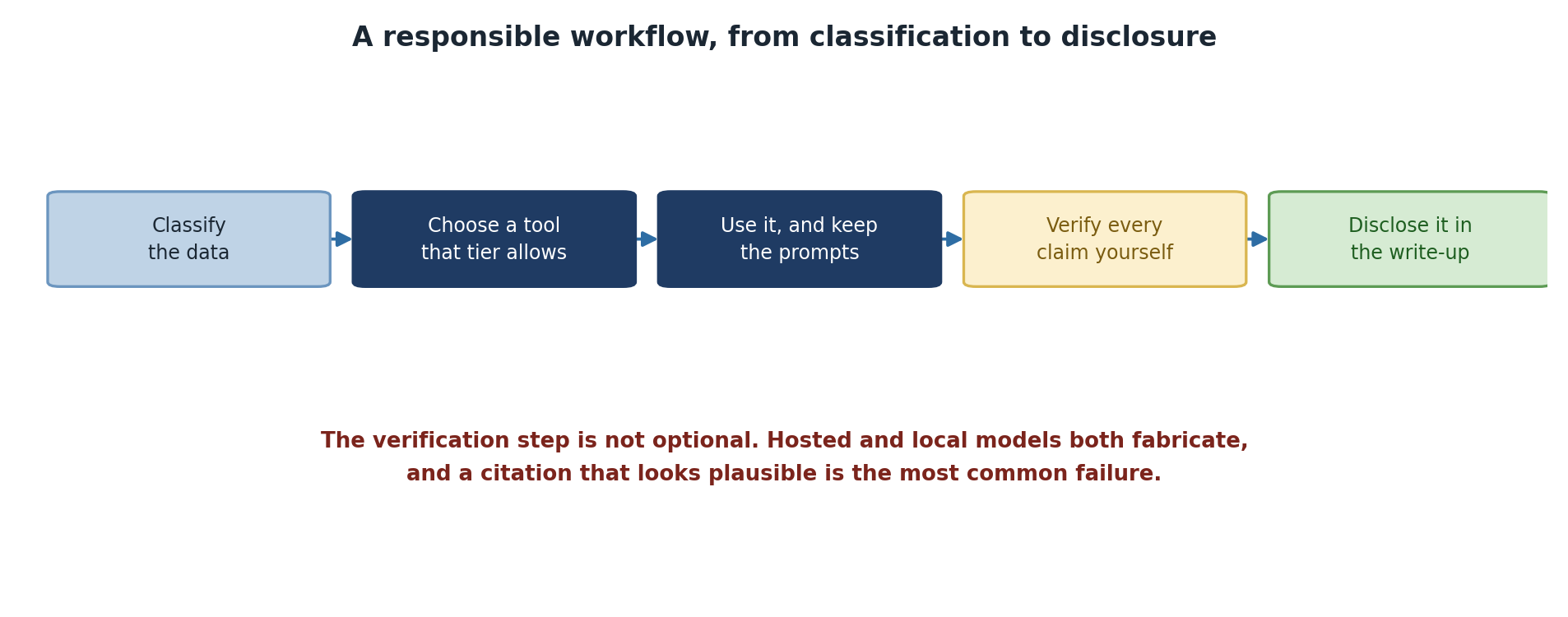
Hallucinations and Verification
AI models generate plausible-sounding text that is sometimes false. LLMs “hallucinate” facts, and confidence is not correlated with accuracy.
Critical verification steps:
- Check factual claims against authoritative sources
- Test all generated code before using it
- Verify citations actually exist and match the claims made
- Treat AI output like a draft that needs fact-checking
Hallucinations Affect All Models
Both cloud and local models hallucinate. Hosted and local models alike confidently generate false information. Never trust AI output without verification, especially in research.
Disclosing AI Use in Publications
In Methods Section:
Statistical analyses were performed in Python 3.11. For interpretation of
preliminary results, we used gpt-oss-20b (OpenAI, Apache 2.0) on Pomona's Sagehen HPC
to generate initial hypotheses, which we then tested using formal statistical
tests. All reported results are based on independent analysis of raw data.
In Code Comments:
PYTHON
# DISCLOSURE: Initial analysis drafted with a local model on Sagehen.
# All numerical results independently verified against raw data.
# AI was not used for statistical inference.
Inadequate vs. Adequate Disclosure
- Bad: “We used AI for analysis” (too vague)
- Bad: No mention of AI at all (violates research integrity)
- Good: “ChatGPT was used to draft the introduction, which was then extensively revised and cited appropriately.”
Disclose Even When It Feels Uncomfortable
Transparent disclosure builds trust. If you omit AI use and it is discovered later, the integrity violation is far more damaging than the admission.
Environmental Impact
Training and running large models consumes significant energy. Mitigate by:
- Using smaller models when possible (Phi-4-mini instead of a 100B-class model)
- Quantizing models (4-bit instead of 32-bit)
- Batching work for efficiency
- Considering environmental impact when choosing scale
Challenge: Audit an AI Output
Get a response from ChatGPT or Claude on a topic in your field. Audit it:
- Verify each factual claim
- Look for missing perspectives
- Identify unstated assumptions
- Note overconfident claims
- Write a paragraph describing what you would change before citing it
Example audit of “What causes ML model failures?”
ChatGPT said: “Models fail because of insufficient data, poor features, and overfitting. The solution is more data, better features, and regularization.”
Audit findings:
- Missing: distribution shift, architecture mismatch, deployment drift
- Assumes “more data” is always possible
- Claims a singular “solution” when multiple exist depending on root cause
- Does not acknowledge that some failures have no simple fix
Revised: “ML models fail for multiple reasons including data quality, feature engineering, overfitting, distribution shift, and organizational testing failures. Solutions depend on root cause analysis.”
- Always disclose AI usage specifically in methods sections and code comments
- Verify all AI-generated claims, citations, and code before use
- AI models hallucinate regardless of whether they are cloud or local
- Transparent disclosure builds credibility; concealment destroys it
- Consider environmental impact when choosing model size and scale