
Pomona's Data Classification System
Last updated on 2026-08-24 | Edit this page
Estimated time: 15 minutes
Overview
Questions
- What data requires encryption at Pomona?
- How do I classify my research data?
- What does gocryptfs protect against?
Objectives
- Understand Pomona’s three-tier data classification system
- Learn what data falls into each tier (PUBLIC, PROPRIETARY, RESTRICTED)
- Know what gocryptfs protects and doesn’t protect
- Understand why encryption alone is not enough
- Learn what “beyond compliance” means for your research
Understanding Pomona’s Three-Tier Data Classification System
Pomona College ITS Policy 24 defines three data tiers. Understanding these is essential for knowing when encryption is required.
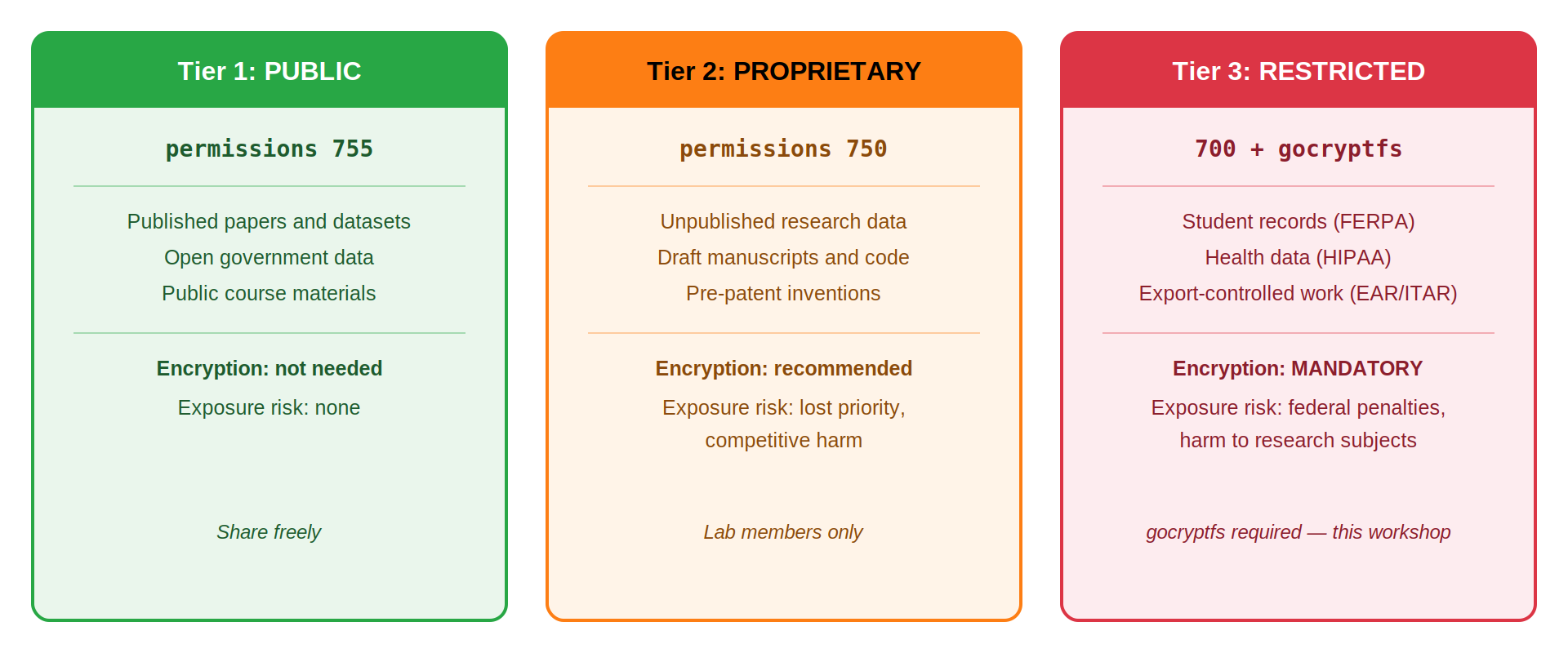
Tier 1: PUBLIC Data (Green, Unix permissions 755)
What it includes: - Published research papers - Anonymized aggregated statistics - Marketing materials - Lecture notes - Published code
Where to store: /bigdata (no encryption required)
Who can access: Everyone
If exposed: No impact
Encryption: Not required
Tier 2: PROPRIETARY Data (Orange, Unix permissions 750)
What it includes: - Unpublished research data (pre-publication) - Preliminary analysis results - Code under development - Industry collaboration data (non-confidential) - Institutional information (committee records) - Internal grant proposals
Where to store: /bigdata or /rhome with group access controls
Who can access: Research group members
If exposed: Competitive disadvantage, loss of publication advantage
Encryption: Recommended but not mandated
Example: Your dataset analyzing crime patterns before publication—valuable because unpublished, but doesn’t directly harm individuals if leaked.
Tier 3: RESTRICTED Data (Red, Unix permissions 700+gocryptfs)
What it includes: - FERPA-protected student records (IDs, grades, transcripts) - Medical information (health records, psychological counseling notes) - Personally identifiable information + sensitive data (names + financial info) - Export-controlled research data (ITAR/EAR) - Proprietary data under NDA or confidentiality agreement - Biometric data - Social Security numbers, passport numbers - Financial account information
Where to store: /bigdata or /rhome with gocryptfs encryption
Who can access: Only authorized researchers with passphrase
If exposed: Legal liability, regulatory fines, personal harm to subjects
Encryption: MANDATORY
Example: Student survey responses with ID numbers; health screening data from a clinical study; export-controlled research in materials science or cryptography.
Legal Requirement: Not Optional
Encryption for RESTRICTED data is not just policy; it’s federal law. FERPA, HIPAA, and EAR violations carry: - Personal legal liability (you, not just the institution) - Criminal penalties (up to $250,000+ per HIPAA violation) - Research suspension (immediate halting of all related work) - Career consequences (difficulty securing future funding)
Failing to encrypt RESTRICTED data can result in disciplinary action, account suspension, and legal consequences. If you have ANY doubt about whether your data needs encryption, encrypt it. Better safe than facing federal investigators.
What gocryptfs Protects
What It DOES Protect
- File contents: Data at rest encrypted with AES-256-GCM (unbreakable with current technology)
- Accidental access: Unauthorized users cannot read encrypted data without passphrase
- Laptop theft: If your computer is stolen, encrypted data remains secure
- Storage media disposal: Old drives or decommissioned systems can be safely discarded
- Compliance with regulations: Satisfies FERPA, HIPAA, EAR, and NIST requirements
- Filename privacy: Even filenames are encrypted (only you see the real structure)
- Storage misconfiguration: Even if accidentally exposed, encrypted files are unreadable
What It DOES NOT Protect
- Active sessions: While mounted, data is accessible in plaintext to anyone on your account
- Weak passwords: gocryptfs is only as secure as your master passphrase (must be 14+ characters)
- Network traffic: Data in transit (SSH, SCP, network copies) is a separate concern (use SSH for transport security)
- Accidental deletion: Encryption doesn’t prevent rm or accidental file deletion
- System administrator access: Root user can access mounted data or read memory
- Malware: If your system is infected, malware can read mounted plaintext data
- Metadata: File sizes, modification times, and directory structure remain visible
- Physical attacks: Forensic recovery from RAM during an active session
Important: Encryption Alone Is Not Enough
gocryptfs protects data at rest, but when mounted, anyone with access to your account can read files. It’s one essential layer in defense-in-depth security:
Additional controls you must use: - Strong, unique passphrases (14+ characters, not dictionary words) - Unmount encrypted directories when not actively working - Use SSH keys (Ed25519 recommended) for cluster access - Enable MFA (DUO) at https://duo.pomona.edu - Keep your system and software updated - Use caution with sensitive data in /scratch or /tmpfs (temporary storage) - Report suspicious activity immediately to its-hpc@pomona.edu
Encryption secures data against theft and misconfiguration, but good security practices secure the system as a whole.
Beyond Compliance: Why Encryption Matters for Your Research
While regulatory compliance is the minimum requirement, encryption provides additional benefits:
Research Integrity and Trust
Encrypted data demonstrates that you take data stewardship seriously. Peer reviewers, collaborators, and funding agencies increasingly expect encryption for sensitive data. It signals institutional rigor.
Competitive Advantage
For unpublished research, encryption protects your competitive advantage. A storage misconfiguration or a compromised credentials shouldn’t expose months of work before publication.
Publication and Reproducibility
Many top-tier journals (Nature, Science, PNAS) now require evidence of data security. Encrypted data at rest is standard practice.
Funding Agency Requirements
NSF, NIH, DOE, and other agencies increasingly require data management plans that include encryption. You may not be allowed to submit grants without demonstrating secure data handling.
Personal Liability Protection
By implementing encryption, you demonstrate due care. In the event of a breach, showing you took reasonable precautions protects you legally.
Challenge: Classify These Datasets
For each dataset below, classify it as PUBLIC, PROPRIETARY, or RESTRICTED under Pomona’s ITS Policy 24. Explain your reasoning.
- A CSV file of published climate measurements downloaded from NOAA for use in an environmental science course.
- An unpublished draft manuscript and supporting statistical analysis for a sociology paper under peer review.
- A spreadsheet containing student names, ID numbers, and final grades for a research study on academic performance.
- Genomic sequencing data from a clinical trial, linked to participant medical records and diagnoses.
- Source code for a custom R package your lab developed but has not yet released publicly.
-
PUBLIC (Green / 755) — Published government data
freely available online. No encryption needed. Store on
/bigdatawith standard permissions. - PROPRIETARY (Orange / 750) — Unpublished research with competitive value. Exposure would mean loss of publication priority, but no legal liability or personal harm. Encryption recommended but not mandated.
- RESTRICTED (Red / 700 + gocryptfs) — Contains student names and ID numbers, which are FERPA-protected personally identifiable information. Encryption is mandatory.
- RESTRICTED (Red / 700 + gocryptfs) — Medical records and diagnoses are HIPAA-protected ePHI. This is the highest-risk category. Encryption is mandatory, and additional access controls are required.
- PROPRIETARY (Orange / 750) — Unpublished code has competitive value but does not contain personally identifiable or regulated information. Encryption recommended, especially if the code implements novel algorithms you plan to publish.
- Pomona’s three-tier system: PUBLIC (no encryption), PROPRIETARY (recommended), RESTRICTED (mandatory)
- RESTRICTED data is legally protected under FERPA, HIPAA, EAR, and NIST requirements
- gocryptfs protects data at rest and prevents accidental exposure from misconfiguration
- Encryption is one layer; defense-in-depth requires strong passphrases, SSH keys, and MFA
- Encryption supports research integrity, publication, and funding compliance
- If you have doubt about data classification, encrypt it