
What is High-Performance Computing?
Last updated on 2026-08-27 | Edit this page
Overview
Questions
- What is high-performance computing (HPC)?
- What is a cluster and how is it different from my laptop?
- What is Sagehen HPC?
Objectives
- Define high-performance computing and understand its role in modern research
- Distinguish between personal computers and HPC clusters
- Identify the key components of an HPC cluster
What is High-Performance Computing (HPC)?
High-performance computing refers to using multiple powerful computers (nodes) together to solve computationally intensive problems much faster than a single personal computer could alone. These computers are networked together into what we call a cluster or supercomputer.
Key Advantages of HPC Clusters
- Massive Parallelism: Run computations across dozens or hundreds of cores simultaneously
- Enormous Memory: Some nodes have 500+ GB RAM (your laptop might have 8-16 GB)
- Specialized Hardware: GPUs, high-bandwidth storage, interconnects optimized for communication
- Resource Sharing: Fair allocation of resources among hundreds of researchers
- Professional Administration: Dedicated IT staff manage hardware, software, security, and backups
- Reproducibility: Jobs run the same way every time, independent of what else is running
Introducing Sagehen HPC
Sagehen (sagehen.hpc.pomona.edu) is Pomona College’s research computing cluster. Named after a bird native to California’s Sierra Nevada, Sagehen brings powerful computing resources to Pomona’s research community.
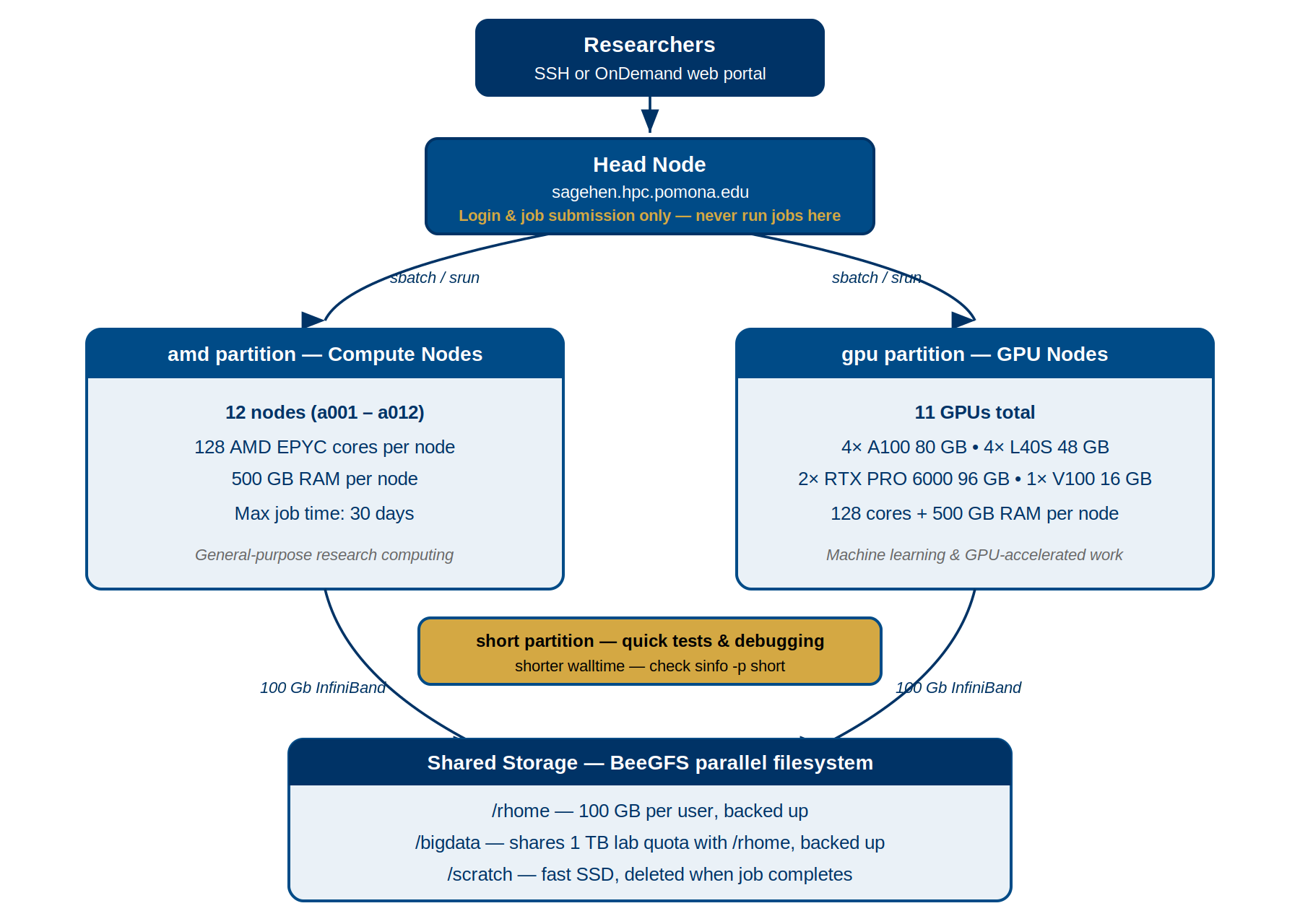
How HPC Clusters Work
The Job Scheduler: SLURM
SLURM (Simple Linux Utility for Resource Management) coordinates all job execution on Sagehen.
How It Works:
- You write a job script describing what you want to run and what resources you need
- You submit the job to SLURM using
sbatchorsrun - SLURM places your job in a queue and monitors resource availability
- When resources become available AND your job has high enough priority, SLURM runs it
- Your job completes and results are written to output files or your home directory
Why SLURM?
- Fairness: Ensures every researcher gets a turn using the cluster
- Efficiency: Runs multiple jobs simultaneously on different nodes
- Reproducibility: Your job runs the same way every time
- Accounting: Tracks resource usage for billing and planning
Challenge 1: HPC vs. Personal Computer
Which of the following tasks would benefit most from running on an HPC cluster instead of your laptop? Select all that apply.
- Writing a research paper in Word
- Training a neural network on 500 GB of image data
- Browsing the web for literature review
- Running a molecular dynamics simulation for 3 weeks
- Checking email
B and D would benefit from HPC.
- A, C, E are everyday tasks that don’t need HPC
- B involves large data and GPU-accelerated computation, perfect for the gpu partition
- D is a long-running simulation that would tie up your laptop for weeks
- High-performance computing enables research that would be infeasible on personal computers
- HPC clusters combine many powerful nodes with fast networks and shared storage
- Sagehen is Pomona College’s HPC cluster, available at no cost to researchers
- SLURM is the job scheduler that manages fair resource allocation among all users